Does GHK-Cu work for skin? Topical vs injectable copper peptide
What controlled trials show about GHK-Cu copper peptide for skin, why most evidence is small or maker-linked, and how FDA treats topical vs injectable.
4 min read · By the Drawline team · Reviewed
Every fact sourced · 6 sources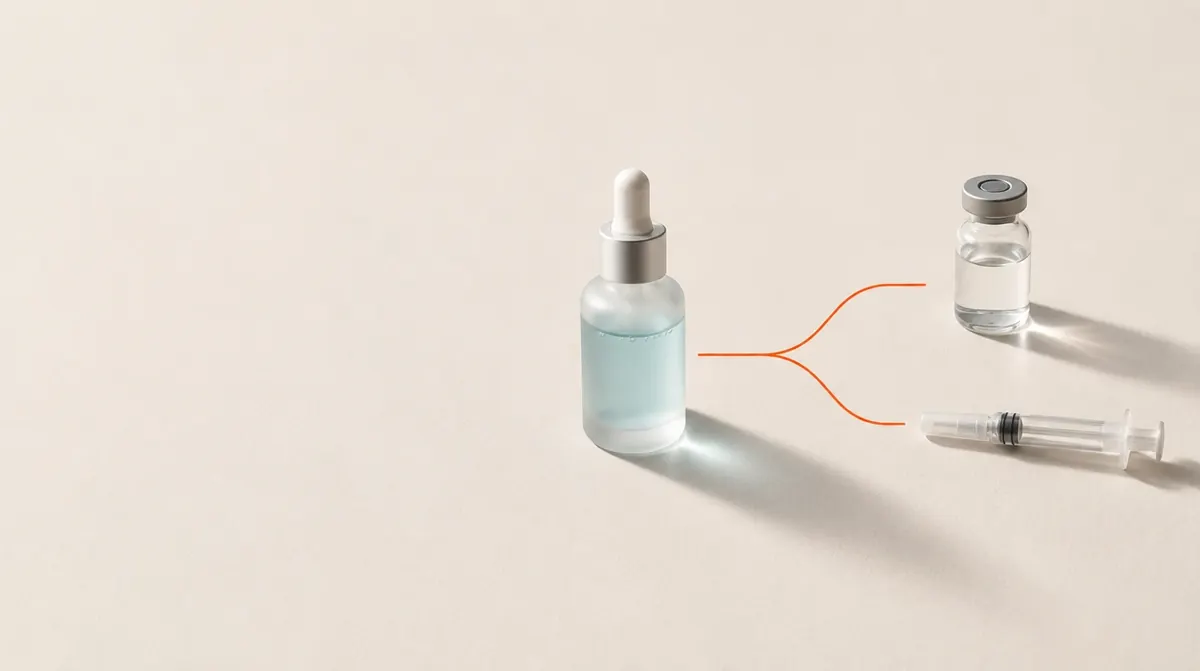
Not in any way that good trials have shown. The few controlled human studies of copper peptide creams are small, and the two randomized trials we could read found no objective benefit over the comparison group. No human studies support injecting GHK-Cu at all.
What GHK-Cu is
GHK-Cu is a tiny peptide (three amino acids) bound to copper. It shows up in two very different places: skin-care creams and serums, and vials sold online for injection. The research behind each is not the same, and neither is the law. See the GHK-Cu profile for a short summary.
What the controlled trials found
- After laser resurfacing (2006): patients had CO2 laser treatment around the mouth, then were randomized to skin care with or without GHK-Cu. Thirteen finished. Blinded evaluators and computer analysis found no difference in redness, wrinkles or overall skin quality between groups. Patients using GHK-Cu did report higher satisfaction on a questionnaire.
- Leg ulcers (1992): a randomized, evaluator-blinded trial in 86 patients with venous stasis ulcers compared a copper tripeptide cream, a silver sulfadiazine cream and an inert placebo. Silver sulfadiazine shrank ulcers more. The copper peptide cream did no better than placebo.
Those are the only randomized human trials of copper peptides we found indexed in PubMed under that study type. A third listed trial was in rabbits.
Where the positive claims come from
Most of the positive human data cited online trace back to a 2018 review written by authors working for a skin-care company. It describes a 12-week facial cream study in 71 women and an eye cream study in 41 women with improvements in fine lines and skin density. Both are cited as 2002 conference abstracts, not full peer-reviewed papers. The review also reports an 8-week serum trial with favorable wrinkle measurements. That is real data, but it is:
- small (dozens of people, not hundreds),
- short (weeks, not years),
- cosmetic (wrinkle depth and skin feel, not disease),
- and often linked to product makers.
Lab and animal studies show GHK can affect collagen genes and wound healing. Lab and animal results often do not carry over to people. Our guide on how strong the evidence is explains how to weigh each kind of study.
Topical vs injectable: two different legal products
FDA sorts products by what they are intended to do, not by the ingredient. Under the Federal Food, Drug, and Cosmetic Act:
- A cosmetic is meant for cleansing, beautifying or altering the appearance. Cosmetics do not need FDA approval before sale (color additives aside).
- A drug is meant to treat disease or to affect the structure or any function of the body. Drugs generally need FDA approval for safety and effectiveness.
FDA gives a direct example: a product intended to remove wrinkles or to increase the skin’s production of collagen is a drug or a medical device, even if it changes appearance. FDA also says “cosmeceutical” has no meaning under the law. So a copper peptide serum sold as a cosmetic can only lawfully promise appearance effects. A claim that it rebuilds collagen turns it into an unapproved drug.
Injectable GHK-Cu is not a cosmetic. Anything injected to change the body is a drug, and no GHK-Cu drug is FDA-approved. FDA has stated a specific safety concern about compounded injectable GHK-Cu, covered in Is GHK-Cu safe?
Topical or injected: which works better?
This is a common search, but there is no head-to-head evidence. No human trial has compared the two routes. Injection has no human efficacy data at all, so it cannot be called the stronger option. The honest answer is that topical use has a little weak evidence and injection has none.
What to take from this
- Treat dramatic “before and after” claims with caution. The controlled data do not back them.
- Read the label claim. A product promising collagen growth is making a drug claim without drug approval.
- If skin aging or wound healing is a real concern, a dermatologist can talk through options that have FDA approval and stronger trials. Our guide on talking to your doctor about peptides can help you prepare.
Drawline does not recommend any product, dose or use. This page is for research and education only.
Sources: PubMed: Effects of topical copper tripeptide complex on CO2 laser-resurfaced skin (Miller et al., 2006); PubMed: Randomized evaluator-blinded trial of two wound healing agents for venous stasis ulcers (Bishop et al., 1992); PMC: Regenerative and protective actions of the GHK-Cu peptide (Pickart and Margolina, 2018); FDA: Is it a cosmetic, a drug, or both?; FDA: Wrinkle treatments and other anti-aging products; FDA: Bulk drug substances nominated under section 503A (updated May 14, 2026).
This guide is for research and educational use. It is not medical advice. Confirm anything that affects your health with a licensed professional.
Last updated · Revision history
First published . Content changed on . Fact corrections are listed in the corrections log, and every changed page on What changed.
Spot a mistake or an out-of-date fact? Report an error. We check every report against the sources.