Alcohol pads before an injection: when, where and how long to let it dry
Wipe the vial stopper before every needle entry and let it dry. What CDC, WHO and the pen and vial leaflets say about alcohol pads, skin and pens.
7 min read · By the Drawline team · Reviewed
Every fact sourced · 20 sources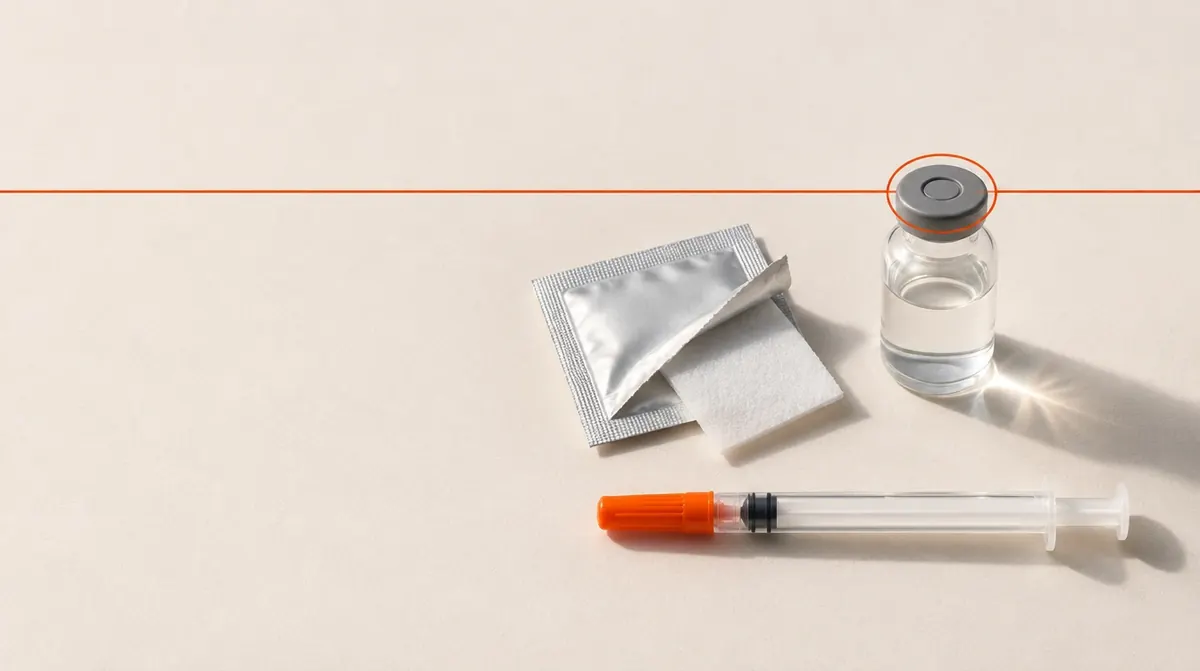
Short answer: wash your hands first. Wipe the rubber stopper of the vial with a new alcohol pad before every needle goes in, and let it dry. Clean the skin the way your product’s Instructions for Use say, then let it air dry before you inject. Do not touch either spot once it is clean. A pad never replaces a new needle and syringe each time.
- Every pen and vial leaflet checked here starts with clean hands.
- The Zepbound, Mounjaro and insulin vial leaflets checked here all say to wipe the rubber stopper with an alcohol swab.
- Most pen and vial leaflets say to wipe the skin with alcohol and let it dry. The Wegovy single-dose pen also allows soap and water.
- WHO’s guidance for health workers lists soap and water, not alcohol, for the skin before a subcutaneous injection. For your medicine at home, follow its own leaflet.
- Let the alcohol air dry. Do not blow on it, fan it or touch it.
Why the stopper matters
A needle that goes through a dirty rubber stopper can carry germs into the medicine. With a multi-dose vial, that medicine is used again for every later dose. CDC says the preservative in a multi-dose vial has no effect on viruses and does not fully protect against bacteria.
That is why the stopper gets cleaned every time, not only the first time:
- CDC tells health workers to disinfect the stopper of a medication vial before putting a needle or other device into it.
- WHO says to wipe the stopper with 70% alcohol on a swab before piercing the vial, and to let it air dry first. It also says not to touch the stopper after disinfecting it.
- CDC traced several large hepatitis B and C outbreaks mainly to used needles put back into multi-dose vials or other shared containers. Its One & Only Campaign sums up the rule for patients and health workers: one needle, one syringe, only one time.
An opened multi-dose vial also has a time limit. See beyond-use date vs expiration date for the 28-day rule.
What the labels and Instructions for Use say
These come from the US labels on DailyMed. Labels change, so check the leaflet in your own box.
- Zepbound and Mounjaro vials (single-dose and multi-dose): list 1 alcohol swab, say to wash your hands with soap and water, then “Wipe the rubber stopper with an alcohol swab.” Their vial steps do not include a separate skin-wiping step.
- Humulin R vial: lists 2 alcohol swabs. Wipe the rubber stopper with one. Wipe the skin with an alcohol swab and let the site dry before you inject.
- Lantus vial: lists 2 alcohol swabs. Wipe the top of the vial, then wipe the skin to clean the injection site and let it dry.
- Novolin N vial: wipe the rubber stopper with an alcohol swab. If you clean the site with an alcohol swab, let it dry before you inject.
- Ozempic pen: wipe the skin with an alcohol swab and let the site dry before you inject.
- Wegovy single-dose pen: clean the site with an alcohol swab or soap and water. Do not touch it after cleaning, and let the skin dry before injecting.
- Bacteriostatic water (Hospira label): use aseptic technique for every entry into and withdrawal from the vial. The label does not list swab steps itself. Wiping the stopper is part of that technique in the CDC and WHO guidance above.
Mixing a powder vial: wipe both stoppers
Mixing (reconstituting) a powder means a needle goes into two vials: the water vial, then the powder vial. Each one is a needle entry, so wipe each stopper with its own new pad and let both dry before the needle goes in. WHO also says to use a sterile needle and syringe for each entry into a multi-dose vial and never to leave a needle in the stopper. The full sequence is in how to reconstitute a peptide vial, and the two kinds of water are compared in bacteriostatic water vs sterile water.
The skin: what labels say and what WHO says
Patient leaflets. Most of the pen and vial leaflets above tell you to wipe the injection site with an alcohol swab and let it dry. The Wegovy single-dose pen also allows soap and water. Novolin N says “if” you clean with alcohol, let it dry.
WHO. WHO’s 2010 injection toolkit for health workers lists soap and water as the skin preparation for a subcutaneous injection, and lists 60–70% alcohol as not needed. It reserves alcohol for venous access, and calls intramuscular injections an unresolved question. MedlinePlus’s insulin injection page also says not to use an alcohol wipe on the injection site, and to wash visibly dirty skin with soap and water.
What that means for you. The sources do not all agree on clean skin. Your product’s leaflet is the instruction approved for that product, so follow it. If your prescriber, nurse or pharmacist told you something different, ask them which applies to you. Where alcohol is used, every source agrees on two things: the skin is clean before you wipe it, and the alcohol dries before the needle goes in.
How to wipe. WHO says to use a single-use swab, wipe from the center of the site outward without going over the same area, apply it for 30 seconds and then let it dry completely. MedlinePlus describes the same center-outward circle.
Let it air dry. Memorial Sloan Kettering tells patients to let the skin air dry and not to fan or blow on it. St. Jude says the same about blowing. One NHS hospital procedure gives a reason to wait: it prevents a stinging feeling when wet alcohol is carried into the tissue by the needle.
How long? The sources give different numbers. St. Jude tells families to let the skin dry for 15 seconds after an alcohol pad. WHO says to apply the alcohol for 30 seconds, then let it dry completely. Most leaflets just say let it dry. Wait until the skin no longer looks wet, and do not touch it to check.
Where to inject and how to rotate sites is in how to self-inject under the skin.
Pens: the seal before a new needle
- Zepbound and Mounjaro KwikPen: “Wipe the red inner seal with an alcohol swab,” then attach a new pen needle.
- Lantus SoloStar: wipe the rubber seal with an alcohol swab before you attach a new needle.
- Ozempic pen and the Wegovy pen that takes a separate needle: their leaflets have no seal-wiping step. They use the alcohol swab for the skin.
- Wegovy single-dose pen: the needle is built in, so there is no seal to wipe.
Every pen leaflet above says to use a new needle for each injection. Storage and discard rules for each pen are in using your pen.
Hands first
Every pen and vial leaflet above tells you to clean your hands before you start, most of them with soap and water. CDC’s steps: wet your hands with clean running water and apply soap, lather, scrub for at least 20 seconds, rinse well, and dry with a clean towel or an air dryer. Then set out your supplies on a clean surface.
Common mistakes
- Reusing a pad, or one pad for everything. WHO says to use a single-use swab. The Humulin R and Lantus vial leaflets list 2 swabs: one for the vial and one for the skin. Use a new pad for each stopper and each site.
- Wiping, then touching. A finger puts germs back. WHO says not to touch the stopper after disinfecting it, and the Wegovy leaflet says not to touch the site after cleaning.
- Injecting before it dries. Every source that uses alcohol says to let it dry first.
- Using a pad that has dried out. A pad works by putting alcohol on the surface. If it feels dry, it has little left to give. Use a new sealed one.
- Wiping dirty skin without washing. WHO and MedlinePlus both say to wash dirty skin with soap and water. Alcohol is not a way to clean off dirt.
- Skipping the stopper wipe on a multi-dose vial. Every medicine vial leaflet above includes it, every time.
- Keeping opened pads or soaked cotton for later. WHO warns that cotton wool soaked in advance and kept in a container becomes highly contaminated. Open each pad just before you use it and throw it away after.
A pad is not enough on its own
No alcohol pad makes a used needle or syringe safe. CDC’s rule is one needle, one syringe, only one time. The Zepbound and Mounjaro leaflets say to use a new syringe and needle for each injection to prevent infections, and never to share them. CDC also says never to leave a needle in a vial stopper for later draws. More in sterile technique and site rotation, and how to get rid of used needles in safe sharps disposal.
When to get help
MedlinePlus says to contact your health care provider if you see signs of infection at an injection site, such as redness, swelling, red streaks or a fever. For a skin infection (cellulitis), it lists redness that grows, warm skin around the redness, swelling, pus, and fever with chills and sweating, and says to contact your provider right away. Call 911 or go to an emergency room if you feel very ill.
- Wash your hands with soap and water.
- Check the vial label and the medicine as your leaflet says.
- Wipe the rubber stopper with a new alcohol pad. Let it air dry and do not touch it.
- Use a new sterile needle and syringe, and draw the way your leaflet or pharmacist showed you.
- Clean the injection site the way your leaflet says, with a new pad (or soap and water where the leaflet allows).
- Let the skin air dry. Do not blow on it, fan it or touch it.
- Inject, then put the needle and syringe straight into a sharps container.
- Wash your hands with soap and water.
- If your pen’s leaflet says so (for example Zepbound and Mounjaro KwikPen, Lantus SoloStar), wipe the seal with a new alcohol pad.
- Attach a new pen needle. Never reuse one.
- Clean the injection site the way your leaflet says, with a new pad (or soap and water where the leaflet allows).
- Let the skin air dry. Do not blow on it, fan it or touch it.
- Inject as your leaflet shows, then put the needle (or the single-dose pen) in a sharps container.
These steps cover clean handling only. Your prescriber sets your dose, and your pharmacist can show you the technique for your product.
Sources: CDC: Core infection prevention and control practices (safe injection practices); CDC: Preventing unsafe injection practices; CDC: Safe injection practices to prevent transmission of infections to patients; CDC: One & Only Campaign; CDC: About handwashing; WHO: Best practices for injections and related procedures toolkit (2010); DailyMed: Zepbound (tirzepatide) label and Instructions for Use; DailyMed: Mounjaro (tirzepatide) label and Instructions for Use; DailyMed: Ozempic (semaglutide) label and Instructions for Use; DailyMed: Wegovy (semaglutide) label and Instructions for Use; DailyMed: Humulin R (insulin human) label and Instructions for Use; DailyMed: Lantus (insulin glargine) label and Instructions for Use; DailyMed: Novolin N (human insulin) label; DailyMed: Bacteriostatic Water for Injection (Hospira) label; MedlinePlus: Subcutaneous (SQ) injections; MedlinePlus: Giving an insulin injection; MedlinePlus: Cellulitis; Memorial Sloan Kettering: How to give yourself a subcutaneous injection using a prefilled syringe; St. Jude Together: Giving subcutaneous injections; Wrightington, Wigan and Leigh NHS Foundation Trust: Procedure for intramuscular injection.
This guide is for research and educational use. It is not medical advice. Confirm anything that affects your health with a licensed professional.
Last updated · Revision history
First published . Content changed on . Fact corrections are listed in the corrections log, and every changed page on What changed.
Spot a mistake or an out-of-date fact? Report an error. We check every report against the sources.