Switching from a GLP-1 pen to a vial: what changes and what doesn’t
A pen measures each dose; a vial makes you measure it. What Zepbound, Mounjaro, Wegovy and Ozempic labels say about vials, syringes, storage and discard dates.
4 min read · By the Drawline team · Reviewed
Every fact sourced · 6 sources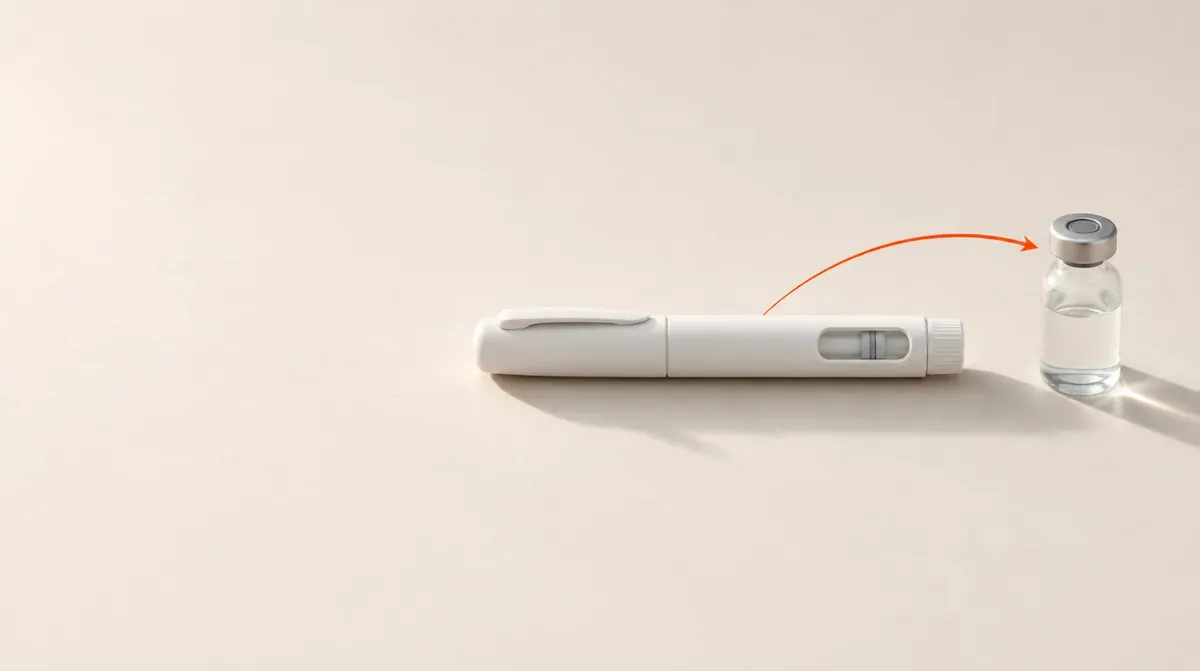
Check your vial draw
The pen to vial calculator shows the draw for the dose on your vial prescription, for Zepbound and Mounjaro vials and compounded semaglutide or tirzepatide.
Open the pen to vial calculatorA GLP-1 pen delivers a set dose in milligrams each time. A vial makes you measure the dose yourself with a syringe, and how much liquid you draw depends on the vial’s concentration. The dose in mg is whatever your prescriber writes; only the way you measure it changes.
What stays the same
- The prescription is in mg. Approved GLP-1 labels state each dose in milligrams. Your prescriber decides the mg dose and any change to it.
- Injection under the skin. Labels for these products describe subcutaneous injection.
- Cold storage before use. Approved pens and vials are refrigerated at 2–8 °C (36–46 °F) and must not be frozen.
What changes
A pen measures the dose for you. The Wegovy single-dose pen instructions say the dose is already set on the pen and it is for one use. On a dial pen such as Ozempic you turn the dose selector until the dose counter shows your prescribed dose; it only stops at the pen’s labeled steps. You do not draw liquid or read a syringe scale.
Vials make you measure it. You draw liquid into a syringe and read the mark. The mark has to match the mg dose at that vial’s concentration.
You need the right syringe. The Zepbound and Mounjaro labels tell clinicians to have vial users choose a syringe suited to the dose, for example a 1 mL syringe that can measure 0.5 mL or 0.6 mL, and to use a new syringe and needle for every injection.
You need new training. Both Lilly labels say that when the prescribed presentation changes, patients should get training for it and read the Instructions for Use for the new presentation.
Lilly vials: single-dose and multi-dose
The current Zepbound and Mounjaro labels (revised August 2026) list four presentations: single-dose pens, single-dose vials, multi-dose vials and a single-patient-use KwikPen.
- Single-dose vials hold 0.5 mL at one of six strengths (2.5 mg to 15 mg per 0.5 mL). The patient instructions say to throw away each opened vial after use, even if medicine is left in it.
- Multi-dose vials hold 2.4 mL and four doses. Each dose is 0.6 mL, and the concentration differs by strength, from 4.17 mg/mL to 25 mg/mL. The label says to throw an opened vial away after 4 weekly doses, 30 days after first use or 30 days at room temperature, even if medicine remains.
Note the pattern: within one Lilly product line the draw volume stays fixed while the concentration changes. A 0.6 mL draw from two different strengths holds two different amounts of drug, so always match the vial to the prescription.
Compounded multiple-dose vials
Compounded vials are not FDA-approved and do not follow one standard. FDA has warned that compounders may offer different concentrations, even from the same pharmacy, and that patients have made serious measuring errors as a result. Your units or mL per dose depend on the concentration printed on your vial, and they change if the concentration changes. See the 5 units vs 50 units mistake.
Storage compared
- Wegovy single-dose pen: refrigerate. If needed, before the cap is removed, it may be kept at 8–30 °C (46–86 °F) for up to 28 days.
- Ozempic pen: after first use, 56 days at 15–30 °C (59–86 °F) or in the fridge.
- Zepbound or Mounjaro single-dose pen or vial: refrigerate. If needed, up to 30 °C (86 °F) for a total of 21 days, then discard.
- Zepbound or Mounjaro multi-dose vial: unopened, refrigerated until the expiry date, or discard after 30 days at room temperature. Once opened, follow the 4-dose and 30-day limits above. Keep it in the carton.
- Compounded vial: follow the pharmacy’s label and beyond-use date. FDA advises against using an injectable GLP-1 that arrives warm or poorly refrigerated.
Before the first vial injection
- Confirm the mg dose on your prescription.
- Read the vial label: product name, strength and concentration in mg/mL, single-dose or multi-dose, and expiry.
- Ask the pharmacist to confirm the volume to draw for that vial and the syringe to use.
- Read the Instructions for Use for the vial, not the pen.
The mg stays the dose your prescriber writes for the vial; only the way you measure it changes. The checker at the top of this page works from the dose on your vial prescription, never from your pen dose. Any change to what you take is for your prescriber to decide, and your pharmacist confirms the draw.
This guide is for research and education. It is not medical or legal advice. Questions about your own prescription belong with your prescriber or pharmacist.
Sources: DailyMed: Zepbound (tirzepatide) prescribing information and Instructions for Use, Eli Lilly (revised August 2026); DailyMed: Mounjaro (tirzepatide) prescribing information and Instructions for Use, Eli Lilly (revised August 2026); DailyMed: Wegovy (semaglutide) prescribing information, Novo Nordisk; DailyMed: Ozempic (semaglutide) prescribing information, Novo Nordisk; FDA: Dosing errors with compounded injectable semaglutide (July 26, 2024); FDA: Concerns with unapproved GLP-1 drugs used for weight loss.
This guide is for research and educational use. It is not medical advice. Confirm anything that affects your health with a licensed professional.
Last updated · Revision history
First published . Content changed on , . Fact corrections are listed in the corrections log, and every changed page on What changed.
Spot a mistake or an out-of-date fact? Report an error. We check every report against the sources.