The 5 units vs 50 units mistake: FDA’s warning on compounded GLP-1 dosing errors
FDA found patients injecting up to 20 times the intended compounded semaglutide by mixing up units, mL and mg. What went wrong and how to double-check.
4 min read · By the Drawline team · Reviewed
Every fact sourced · 2 sources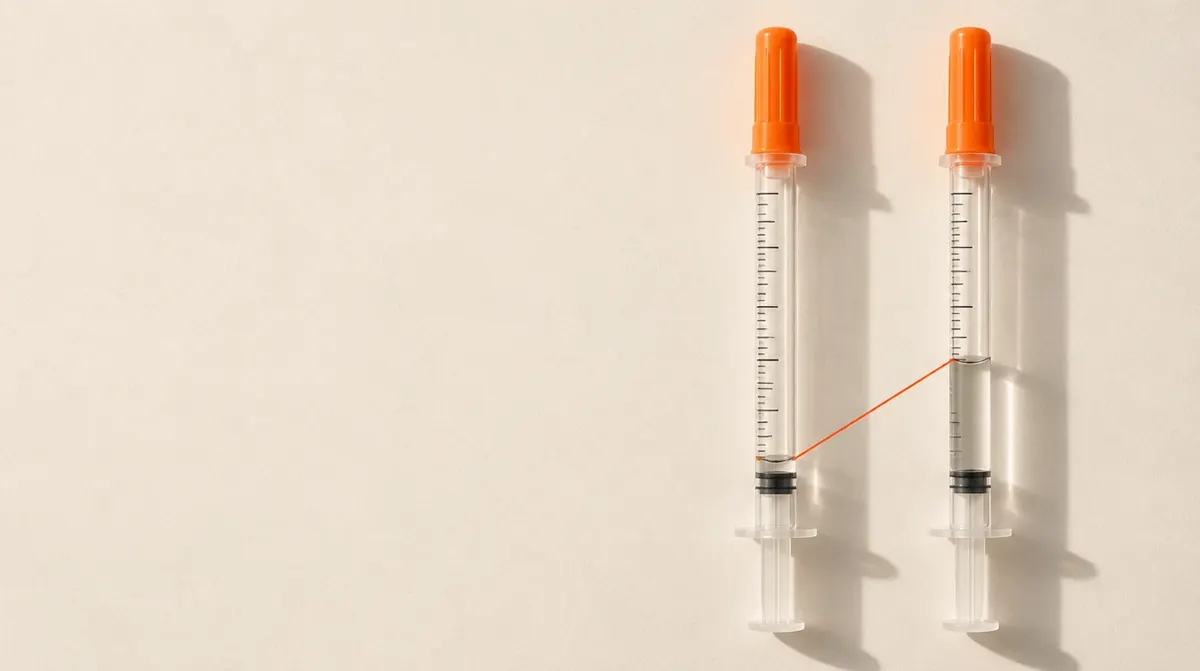
In July 2024 FDA warned that patients using compounded semaglutide from multiple-dose vials were injecting 5 to 20 times the intended amount, most often by drawing 50 units on the syringe when told to draw 5. The root cause was confusion between units, milliliters and milligrams.
What FDA reported
FDA’s alert of July 26, 2024 described medication errors, not defective products:
- Measuring errors by patients. Most reports involved patients drawing more than prescribed from a multiple-dose vial. Several were told to draw 5 units (0.05 mL) on a U-100 insulin syringe and drew 50 units instead, ten times the volume.
- Calculation errors by clinicians. Some providers made mistakes converting milligrams into units or milliliters, leading to doses 5 to 10 times what was intended. In one case a prescription said 25 units when 5 units (0.25 mg) was meant. In another it said 20 units when 2 units was meant.
- Other cases. One patient could not get clear instructions from a telemedicine prescriber, searched online and took five times the intended amount. A provider who worked out their own dose in units injected ten times the intended amount.
- Syringe size. Some patients received syringes much larger than the prescribed volume, such as a 1 mL syringe for a very small draw.
Reported effects included nausea, vomiting, abdominal pain, fainting, headache, migraine, dehydration, acute pancreatitis and gallstones. Some patients needed medical care and some were hospitalized.
Why compounded vials invite this mistake
FDA pointed to three factors: patients new to drawing from a vial, confusion between mg, mL and “units,” and differing concentrations. Approved semaglutide comes in pens dosed in milligrams at standard concentrations. Compounders may offer several concentrations, even from the same pharmacy. So a unit count that was right for one vial can be wrong for the next.
FDA’s updated GLP-1 concerns page, current as of October 1, 2026, still lists dosing errors with compounded semaglutide, including some reports that needed hospitalization and some where clinicians miscalculated.
Three measurements, three meanings
- mg (milligrams) is the amount of drug. Approved GLP-1 pens are dosed in mg.
- mL (milliliters) is the volume of liquid.
- Units on a U-100 insulin syringe are volume marks. 100 units is 1 mL, so 1 unit is 0.01 mL. Units say nothing about mg until you know the concentration.
More on syringe scales in how to read insulin syringe units. The numbers behind this warning are collected in GLP-1 and injection dosing error statistics.
Worked example: same units, different mg
Take two vials of the same drug at two concentrations. These numbers are arithmetic only. They are not a dose for anyone.
- Vial A is labeled 2.5 mg/mL. A draw to the 10-unit mark on a U-100 syringe is 0.10 mL. 0.10 mL × 2.5 mg/mL = 0.25 mg.
- Vial B is labeled 5 mg/mL. The same 10-unit draw is still 0.10 mL. 0.10 mL × 5 mg/mL = 0.5 mg.
The syringe reading is identical, yet vial B delivers twice the drug. Now reverse it: the same 0.25 mg needs 10 units from vial A but 5 units from vial B. That is why a unit count is only valid for one specific concentration, and why it must be recalculated whenever the vial changes.
How to double-check
- Read the label every time. Find the concentration in mg/mL. Compare it with your last vial.
- Get the instruction in mg and in volume. Ask your prescriber or pharmacist to state both the mg dose and the mL or unit draw for this exact vial.
- Confirm the draw with the pharmacist before the first injection from any new vial. FDA encourages patients to ask their provider or compounder how to measure and give the intended dose.
- Use a syringe sized for the draw. FDA encourages providers and compounders to supply the right syringe size. Check the syringe is U-100 if your instructions are in U-100 units. Very small draws are the hardest to measure: see insulin syringe accuracy at small doses.
- Watch for a tenfold slip. 5 and 50 units, or 0.05 and 0.5 mL, look alike when written quickly.
- Do not convert on your own from online charts. One case in FDA’s alert began exactly that way.
The mg to units converter does the arithmetic, but it cannot know what you were prescribed or whether the label is right. Treat it as a check against what your pharmacist told you, not a replacement for it.
If something goes wrong
If you think you injected too much, contact your prescriber or pharmacist, or call Poison Control. Call 911 for severe symptoms. FDA asks patients and clinicians to report errors and side effects to MedWatch.
This guide is for research and education. It is not medical or legal advice. Questions about your own prescription belong with your prescriber or pharmacist.
Sources: FDA: FDA alerts health care providers, compounders and patients of dosing errors associated with compounded injectable semaglutide products (July 26, 2024); FDA: Concerns with unapproved GLP-1 drugs used for weight loss (current as of October 1, 2026).
This guide is for research and educational use. It is not medical advice. Confirm anything that affects your health with a licensed professional.
Last updated · Revision history
First published . Content changed on . Fact corrections are listed in the corrections log, and every changed page on What changed.
Spot a mistake or an out-of-date fact? Report an error. We check every report against the sources.